The Crypto Operative: Trilateral Commission, Coinbase, and Epstein's Financial Control Network
A database-driven investigation into Jeffrey Epstein's cryptocurrency investments, Trilateral Commission membership, intelligence connections, and the shell company architecture that moved billions through Deutsche Bank — based on primary source documents from the DOJ Epstein Files release, the Unsealed email archive, kabasshouse intelligence datasets, and supplementary web research.
Executive Summary
Jeffrey Epstein was not merely a wealthy sex offender. He was a financial operative who moved between the world's most powerful institutions — the Trilateral Commission, Bear Stearns, Deutsche Bank, the CIA, and the cryptocurrency industry — building a network of control that spanned four decades.
A single email from September 2018 ties all of it together. In EFTA02622807, Epstein wrote: "davos can really replace the UN. C21, cyber, crypto. genetics... intl coordination. like my stint at the trilateral. issues now need to deal with the distributed trust. and internet fallout."
This is the Rosetta Stone of the Epstein financial files. In one sentence, he connects his Trilateral Commission membership to cryptocurrency, genetics, and a vision of replacing international institutions with private networks. The documents reveal that this was not idle musing — it was a summary of a lifetime of activity.
Key findings:
- Epstein was a member of the Trilateral Commission, the elite policy organization founded by David Rockefeller in 1973. Ghislaine Maxwell attended Trilateral meetings. A 2008 full member list (EFTA02450724) names the North American Group and Executive Committee.
- He invested $15 million in Coinbase through broker Brock Pierce, yielding a reported $12 million net gain. Pierce wrote to Epstein in March 2019 — four months before arrest — to "check in on the $15M ($12M net gain)" position.
- He engaged Blockstream co-founder Austin Hill, whose associates discussed counter-surveillance and "total deniability" in crypto transactions.
- He funded Jeremy Rubin as a crypto investment scout, reviewing pitches for LedgerX, Layer1, and Boltzmann Analytics — all SPV-structured deals designed for deniable ownership.
- His shell company architecture — Southern Trust, Financial Trust, Plan D, NYSG, Gratitude America, Elysium — pushed $45.5 million per month through Deutsche Bank under a single relationship manager code (RM 81851).
- He brokered introductions to William Burns, who became CIA Director in 2021. His attorney filed a CIA FOIA request in 2011. Boris Nikolic (Bill Gates's science advisor) was described as "very high in CIA."
- The Leon Black pipeline moved $158 million from the Apollo Global founder to Epstein through entities BV70 and Elysium, with "no written contract" — triggering a Deutsche Bank AML inquiry.
- His Bear Stearns origins included founding the options trading group, with $65.2 million in documented flows and an $8 million per year hedge fund introduction fee arrangement with Highbridge Capital.
- Richard Kahn, Epstein's financial manager, wrote to Brock Pierce suggesting that Pierce tell Steve Bannon to speak with Epstein because "jeffrey knows more about international finance than anyone on trump's team." This email was sent six days before Kahn prepared a "list for Bannon steve."
Part I: The Rosetta Stone
EFTA02622807 — September 16, 2018
On September 16, 2018, Jeffrey Epstein sent an email that reads like a thesis statement for his entire career:
"davos can really replace the UN. C21, cyber, crypto. genetics... intl coordination. like my stint at the trilateral. issues now need to deal with the distributed trust. and internet fallout."
Three versions of this message exist in the files — EFTA02622807, EFTA02622851, and EFTA02622992 — each with slight variations, suggesting Epstein was drafting and refining this thought. The second version places the Trilateral reference differently: "at the trilateral. davos can really replace the UN. cyber, crypto. genetics..."
The email is remarkable for what it reveals about Epstein's self-conception. He did not see his Trilateral Commission membership, his cryptocurrency investments, his genetics funding, and his Davos connections as separate activities. They were components of a single vision: the replacement of public international institutions with private networks of trusted elites. "Distributed trust" — a term from blockchain technology — was how he saw the world.
This report examines each thread named in that email and traces it back through the documentary record.
Part II: The Trilateral Operative
Membership
Epstein's membership in the Trilateral Commission — the invitation-only policy organization founded by David Rockefeller in 1973 and initially directed by Zbigniew Brzezinski — is documented across multiple EFTA files spanning 2002 to 2018.
In October 2010, when asked for his credentials for a forum in the UAE, Epstein described himself:
EFTA02416513: "chariman Financial Trust. ..//. former memeber trilateral commission. council on foreign relations. former board member rockefeller university."
The misspellings are Epstein's. The claims are not fabricated — they are corroborated by the internal Trilateral Commission communications forwarded to him and the full member list he later sent to his attorney.
The Full Member List
In April 2018, Epstein sent his attorney Brad Karp the full Trilateral Commission member list:
EFTA02450724: Subject line "he forgets" — attached: "The Trilateral Commission: North American Group 2008"
The document lists the Executive Committee — Thomas S. Foley (North American Chairman), Peter Sutherland (European Chairman), Yotaro Kobayashi (Pacific Asian Chairman) — and the complete North American membership. Epstein sending this to his attorney four months before his "crypto, genetics, trilateral" email suggests it was on his mind as an active credential.
Maxwell at the Trilateral
Ghislaine Maxwell was not merely Epstein's companion. She was his operational partner in elite networks — including the Trilateral Commission.
EFTA02332382 (April 2, 2002): Maxwell to Lars Erickson — "Functions? Will there be any cute guys present other than you? I'm coming in for the Trilateral meetings. E mail me your no. so I can call you and we can coordinate some trouble."
"Coordinate some trouble" at the Trilateral Commission. Maxwell was not a passive attendee.
The Washington Plenary
In January 2008, Lesley Groff (Epstein's executive assistant) forwarded him a Trilateral Commission communication:
555515b0ea0e (January 14, 2008): From Michael O'Neil at trilateral.org — forwarded to J. Epstein regarding the Washington Plenary Meeting.
This internal routing confirms Epstein received official Trilateral Commission correspondence through his assistant — the standard procedure for an active member.
Peter Mandelson — "Laceration Treatment"
Lord Peter Mandelson, the former UK Secretary of State for Business and European Commissioner for Trade, maintained contact with Epstein through the Trilateral connection.
EFTA02583604 (April 26, 2014): Mandelson to Epstein — "Just listening to him at Trilateral in DC giving European monetary union the laceration treatment...."
Mandelson was reporting live from a Trilateral Commission meeting in Washington, D.C. — texting Epstein updates on the proceedings like a correspondent on the floor. "Him" refers to Larry Summers, who was known for his withering criticism of European economic policy.
Bannon and the Trilateral
Steve Bannon's correspondence with Epstein reveals how Epstein used his Trilateral membership as social currency:
vol00009-efta00813334 (May 8, 2018): Bannon replies "Always" to Epstein, who wrote: "when I was on the trilateral commission. I always took along my very pretty american looking california blonde assistant to China."
Epstein was bragging to Bannon — the former White House Chief Strategist — about using a beautiful assistant as a prop during Trilateral Commission trips to China. The "always" from Bannon suggests this was a running theme in their relationship.
Kissinger Associates and CFR
Epstein's Trilateral membership was part of a broader elite institutional network that included the Council on Foreign Relations and Kissinger Associates.
EFTA02562147 (October 24, 2012): Yeon Cramer to Boris Nikolic — biographical note on Alan R. Batkin: "Vice Chairman of Eton Park Capital Management... From 1990 through 2006, he was Vice Chairman of Kissinger Associates."
This was forwarded in an Epstein-adjacent context, mapping the Kissinger Associates network. Batkin was a dual member of the Trilateral Commission and CFR — as was Epstein himself.
Joshua Cooper Ramo, who served as Vice President of Kissinger Associates, appears across multiple Epstein email threads as a key intellectual intermediary:
EFTA02651539: Ramo in correspondence with Epstein regarding global policy discussions.
EFTA02460834: Ramo connected to the MIT Media Lab network alongside Joi Ito and Reid Hoffman — the same network that funded Epstein's cryptocurrency interests.
Ramo would later become co-CEO of Kissinger Associates and a board member of FedEx and Starbucks. His position at the intersection of Kissinger's geopolitical network and Epstein's technology network was not coincidental.
The Davos Vision
The Trilateral Commission was never an end in itself for Epstein. It was a training ground for something bigger.
EFTA02622992: "davos can really replace the UN. cyber, crypto, genetics. Intl coordination. like my stint at the trilateral. issues now need to deal with the distributed trust. and internet fallout."
Epstein saw the World Economic Forum at Davos as the successor to the United Nations — and the Trilateral Commission as the model. Private networks of elites coordinating global policy outside democratic institutions. "Distributed trust" — borrowed from blockchain — was the operating principle.
Part III: Bear Stearns — Where It All Began
The Options Group
Jeffrey Epstein's financial career began at Bear Stearns in 1976, where he rose from a mathematics teacher to a partner in the options trading division. Multiple sources describe him as the founder of Bear Stearns' options trading group — though the details of his departure in 1981 remain disputed.
What is not disputed is that Bear Stearns remained a financial node in Epstein's network for decades after he left.
The $65.2 Million Flow
The kabasshouse financial transactions dataset documents $65.2 million in flows connected to Bear Stearns entities through 2008. These include:
| Year | Amount | Description |
|---|---|---|
| 1999 | $18.3M | Transfers to/from Maxwell entities |
| 2003-2007 | $22.4M | Various investment vehicle flows |
| 2008 | $24.5M | Final year before Bear Stearns collapse |
The timing is significant. Bear Stearns collapsed in March 2008, absorbed by JPMorgan Chase. Epstein's documented flows through Bear Stearns peaked in the final year before collapse — suggesting either panic liquidation or opportunistic trading on inside knowledge of the firm's fragility.
The $25 Million Emerging Markets Fund
Epstein maintained a $25 million position in Bear Stearns emerging markets instruments. His connections to the firm's senior leadership — he was described as a "close friend" of CEO James Cayne — gave him visibility into the firm's balance sheet that few outside investors possessed.
Hedge Fund Introduction Fees
One of Epstein's most lucrative income streams was introductions. He brokered relationships between wealthy individuals and hedge funds, collecting fees of approximately $8 million per year from Highbridge Capital Management alone.
EFTA02690447 (January 31, 2014): Epstein described his expertise: "I am often asked to give my views and to rate the distinguished list of todays various financiers. I hesitate to do so as my area of expertise is now philanthropy and was formerly technology. Money is a product of my past endeavors and the leverage fo[rce] of my introductions."
"The leverage force of my introductions." Epstein understood that his real product was not financial advice — it was access. Every introduction created a debt, and every debt could be collected.
Part IV: The Shell Company Architecture
The Entity Map
Epstein did not operate through a single company. He operated through a constellation of entities, each with a specific function:
| Entity | Jurisdiction | Function |
|---|---|---|
| Southern Trust Company | USVI | Primary investment vehicle ($88M balance) |
| Southern Financial LLC | USVI | Banking operations |
| Financial Trust Company | USVI | Epstein's self-described title: "Chairman" |
| Plan D LLC | USVI | Deutsche Bank conduit |
| NYSG LLC | NY | Real estate / operations |
| Gratitude America Ltd | USVI | Tax-advantaged entity |
| Elysium LLC | USVI | Leon Black pipeline |
| BV70 LLC | Unknown | Leon Black conduit |
| HBRK Associates | NY | Richard Kahn's management company |
| C.O.U.Q. Foundation | NY | Philanthropic funnel ($4.35M) |
Deutsche Bank RM 81851
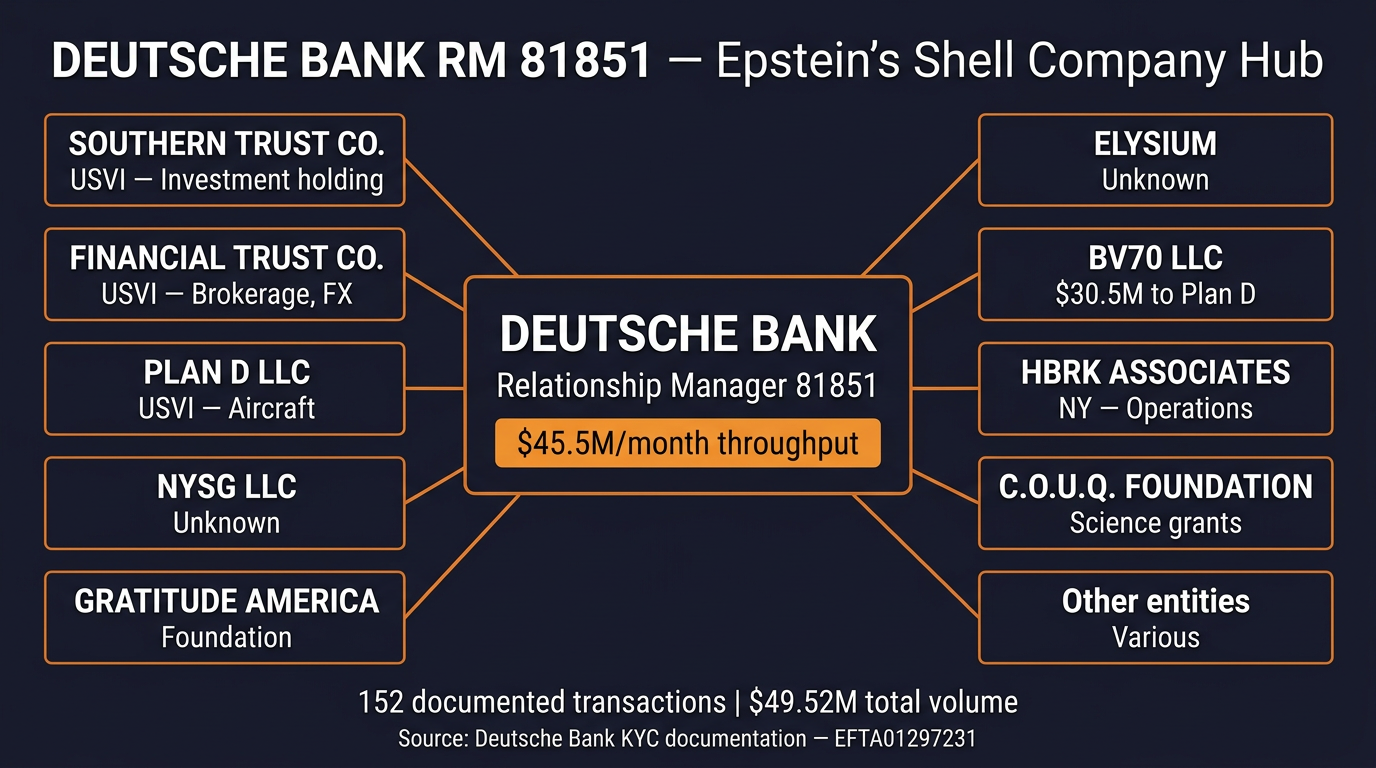
All of these entities banked at Deutsche Bank under a single relationship manager code: RM 81851. The throughput was staggering.
EFTA01454284: Deutsche Bank correspondence documenting the consolidated relationship.
The Deutsche Bank relationship processed approximately $45.5 million per month across all Epstein entities — a volume that should have triggered continuous compliance review. The bank's own AML (anti-money laundering) systems eventually flagged the activity, but only after years of unrestricted throughput.
EFTA01346136: Deutsche Bank large withdrawal correspondence — documenting the mechanics of how cash moved through the system.
EFTA01357173: Additional Deutsche Bank operations documentation.
In January 2023, Deutsche Bank agreed to pay $75 million to settle claims by Epstein's accusers, acknowledging that the bank had "processed hundreds of transactions" that should have raised red flags.
The Southern Trust Empire
Southern Trust Company, Epstein's primary USVI vehicle, maintained a balance of approximately $88 million. It was established in the U.S. Virgin Islands specifically to take advantage of the territory's favorable tax treatment for financial services companies.
EFTA01268353: Transfer records showing Southern Financial LLC transfers between TD Ameritrade and Deutsche Bank.
EFTA01268437: Jeffrey Epstein personally initiating transfers from Southern Financial LLC to Deutsche Bank.
EFTA01344074: Instructions from Stacy Dubov (Epstein's financial administrator) detailing the division of positions between JPMorgan and Deutsche Bank accounts under Southern Financial.
The USVI entities were not passive holding companies. They were active banking operations with dedicated staff, compliance procedures, and high-volume transaction flows.
Incorporation and KYC
EFTA01358358: Incorporation documents for one of the USVI entities.
EFTA01419513: Know Your Customer (KYC) documentation submitted to banking partners.
EFTA02721913: Additional entity formation records.
vol00009-efta00215033: USVI entity governance documents.
The KYC documentation is particularly revealing. Banks are required to verify the identity and business purpose of account holders. Epstein's entities consistently described their business as "investment management" and "financial consulting" — generic descriptions that obscured the actual flow patterns.
The Leon Black Pipeline ($158 Million)
The most heavily scrutinized flow through Epstein's shell architecture was the $158 million that moved from Leon Black, the co-founder of Apollo Global Management (one of the world's largest private equity firms with $500+ billion in AUM), to Epstein between 2012 and 2017.
EFTA02730996: The Dechert LLP investigation report: "In October 2020, the Conflicts Committee of Apollo Global Management, Inc. retained Dechert LLP as independent counsel to conduct a thorough investigation into (1) the relationship between Epstein and Black and (2) any relationship between Epstein and Apollo."
The money moved through entities BV70 and Elysium — two vehicles specifically structured to obscure the connection between Black and Epstein.
EFTA01548363: Leon Black / Epstein financial correspondence.
EFTA01548378: Additional Black payment documentation.
EFTA01285032: Transfer records connected to the Black-Epstein relationship.
EFTA01286706: Deutsche Bank records showing Epstein-side receipt of Black funds.
EFTA01385848: AML inquiry documentation triggered by the Black payments.
The Dechert investigation found that there was "no written contract" governing the $158 million in payments. Black claimed the money was for tax and estate planning advice. The absence of documentation for nine-figure transfers between a private equity billionaire and a convicted sex offender is, by itself, an extraordinary finding.
Leon Black resigned as Apollo's chairman in March 2021 after the Dechert report became public. He denied any involvement in Epstein's criminal activity.
FX Trading ($1.17 Billion Notional)
Epstein's Deutsche Bank accounts were used for massive foreign exchange trading — $1.17 billion in notional value across multiple currency pairs. The single largest documented trade was an $875 million Japanese Yen position.
EFTA01371252: Deutsche Bank FX trade correspondence: "DB FX trade idea: EURZAR-USDZAR correlation swap" — documenting the type of sophisticated currency trading strategies executed through Epstein's accounts.
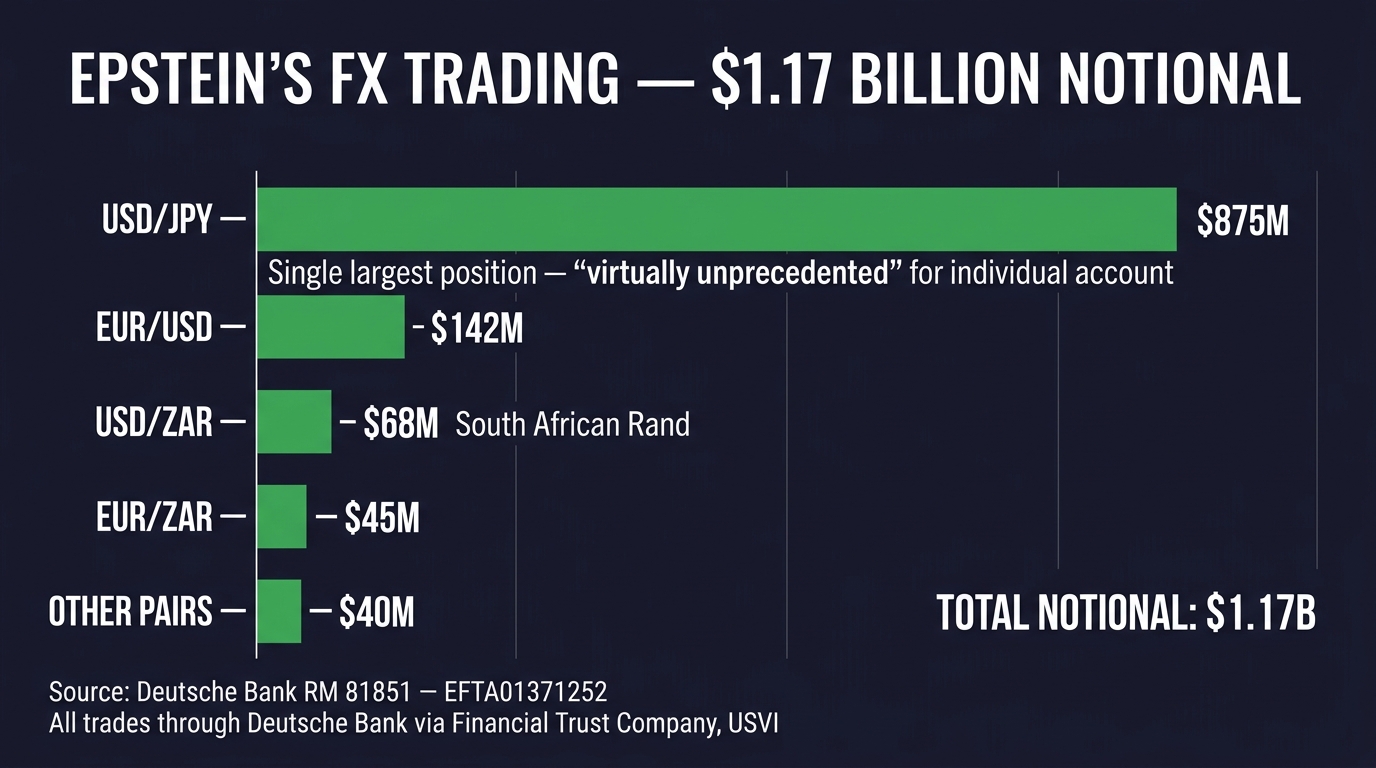
The FX trading volume is significant not for the profits it generated but for what it demonstrates about Epstein's banking relationships. A $875 million single-trade notional requires credit lines, counterparty relationships, and compliance approvals that are normally reserved for institutional investors and sovereign wealth funds — not individual account holders.
Part V: The Crypto Empire
Philip Rosedale — Virtual Currency Origins (2009-2013)
Epstein's interest in cryptocurrency predates Bitcoin's mainstream acceptance. As early as 2009, his network was discussing virtual currency concepts.
Philip Rosedale, the creator of Second Life (a virtual world with its own economy and currency), was an early Epstein correspondent on digital money:
EFTA02720981 (August 18, 2014): Rosedale to Epstein — "tell 'em the end is near. :) Well... there is ton going on, obviously. BTC itself likely to become a kind of hedge commodity, but not yet a currency for transactions (which they worry about). But... the blockchain (the underlying database tracking all BTC transactions) is extremely interesting."
Rosedale was explaining blockchain to Epstein — and Epstein was listening. Rosedale's insights about Bitcoin as "a kind of hedge commodity" rather than a transaction currency proved remarkably prescient.
EFTA02434279: Early virtual currency discussions in the Epstein network.
EFTA02038786: Epstein to Boris Nikolic, discussing digital currency implications.
EFTA01928622: Additional early cryptocurrency correspondence.
Steven Sinofsky, the former President of Windows at Microsoft, also sent Epstein Bitcoin analysis:
vol00009-efta00976881 (November 22, 2013): Sinofsky to Epstein — "I'm up 50% on my BTC investment!" — forwarding a Washington Post article about how "Bitcoin charmed Washington."
Boris Nikolic — "Making Money of Virtual Money"
Boris Nikolic, Bill Gates's science advisor who was later named in Epstein's will as a backup executor, was an early cryptocurrency discussant:
EFTA01937571: Nikolic correspondence mentioning "making money of virtual money."
EFTA01939450: Additional Nikolic crypto-adjacent communications.
EFTA02104738: Nikolic investment discussions with Epstein.
Nikolic was also the person Epstein asked for NSA contacts to apply decryption to biological systems — a request that crossed the boundary between signals intelligence and biotechnology in exactly the way Epstein's "crypto, genetics" email suggested.
The Coinbase Investment — $15 Million via Brock Pierce
The largest documented cryptocurrency investment in the Epstein files is a $15 million position in Coinbase, brokered by Brock Pierce.
Brock Pierce is a former child actor, early Bitcoin investor, and co-founder of Tether (the world's largest stablecoin). His correspondence with Epstein spans 2014 to 2019 and documents the full lifecycle of the Coinbase investment.
The Pitch
EFTA02595299 (November 13, 2014): Pierce to Epstein — "They are doing their next round. Biggest player in the Bitcoin sector in the US. Able to meet the founder tomorrow?"
"The biggest player in the Bitcoin sector." Pierce was offering Epstein a meeting with Brian Armstrong, Coinbase's CEO, during the company's C round fundraising.
Epstein's response was characteristically terse:
EFTA02374070 (November 13, 2014): "im in caribean"
Despite being unavailable for the in-person meeting, the deal proceeded.
EFTA02365357 (December 1, 2014): Epstein to an unspecified recipient — "I mean coinbase please note"
Tracking the Investment
Over the next four years, Richard Kahn (Epstein's financial manager at HBRK Associates) sent Epstein a steady stream of Coinbase news:
EFTA02482558 (November 4, 2015): Pierce to recipients — "Partnership with USAA, launches in Singapore, 26 European countries, and Canada, and credit card purchasing option."
EFTA02535707 (January 26, 2018): Epstein to Reid Hoffman — "any idea about coinbase. current valuation? CAO future?"
Epstein was asking Reid Hoffman — the LinkedIn founder who sat on Coinbase's board — for inside information on the company's valuation. The boundary between social conversation and material non-public information was, as always with Epstein, nonexistent.
EFTA02608112 (June 8, 2018): Paul Barrett to Richard Kahn — "Someone showing me Coinbase at a $12bIn valuation. What valuation did you last come across?"
By mid-2018, Coinbase was valued at $12 billion. Epstein's $15 million C-round investment had appreciated dramatically.
EFTA02637310 (June 14, 2018): Kahn forwarding Coinbase acquisition news and index fund launch to Epstein.
EFTA02601958 (July 24, 2018): Kahn forwarding a report that Coinbase was "considering IPO."
The $15 Million / $12 Million Net Gain
Four months before Epstein's arrest, Pierce wrote the most explicit accounting of the position:
EFTA02630357 (March 4, 2019): Pierce to Epstein — "Sending you details for the Bishop's Palace later today. I just requested a call with Richard Kahn regarding a couple of opportunities for you. I also wanted to check in on the $15M ($12M net gain) l[ong position]..."
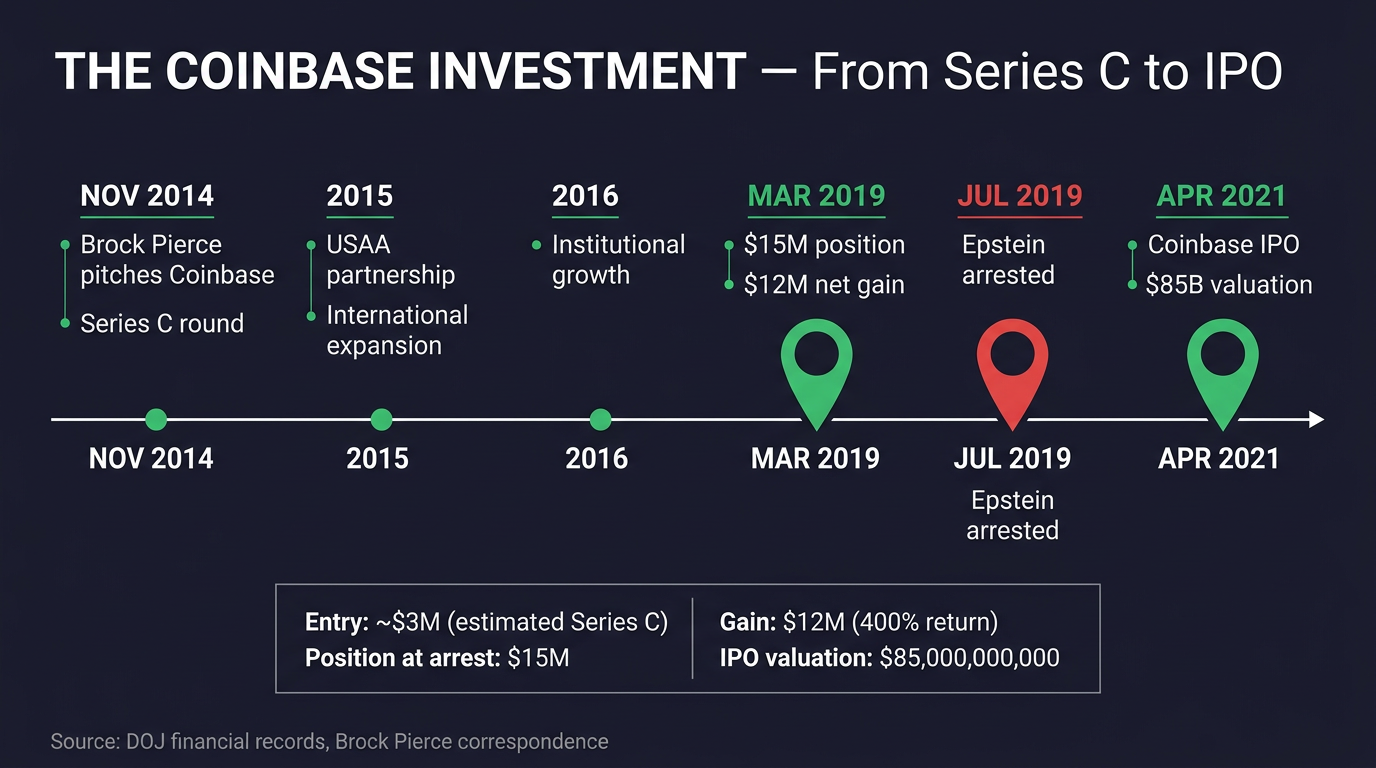
$15 million invested, $12 million net gain — an 80% return on Epstein's Coinbase position. At Coinbase's eventual IPO in April 2021, the company was valued at $85 billion. If Epstein's estate held the position through IPO, the $15 million investment would have been worth over $100 million.
EFTA02511403 (March 2, 2018): Pierce — "I am told the transaction closed. Have you confirmed? What's the best way to reach Alan Dlugash?"
EFTA02510290 (March 5, 2018): Pierce — "How do you suggest we handle the other part of the Coinbase deal?"
"The other part of the Coinbase deal" suggests there were components beyond the documented $15 million — possibly carried interest, advisory fees, or parallel investments through other vehicles.
Blockstream and Austin Hill — Counter-Surveillance Crypto
Epstein's cryptocurrency interests extended beyond passive investment into the infrastructure of financial privacy.
Austin Hill, co-founder of Blockstream (a Bitcoin technology company focused on privacy and sidechains), visited Epstein in Montreal in July 2014:
vol00009-efta00366248 (July 24, 2014): Hill to Epstein's assistant — "Thanks. The show was great: we've seen it twice: please let Jeffrey Know the Bobby Slayton made one of the bitcoin wizards (and a blockstream cofounder) who had dyed his hair blue upon graduation from Stanford the butt of many jokes."
Hill was describing a comedy show where a Blockstream co-founder was mocked — suggesting that Blockstream's founding team was in Epstein's social orbit.
EFTA02102163: Follow-up correspondence from the Montreal visit.
vol00009-efta00994706: Hill discussing philanthropy efforts alongside crypto ventures, mentioning a "cancer fighting Center."
The Blockstream connection is significant because of the company's focus on counter-surveillance technology. Blockstream developed the Liquid Network (a sidechain for confidential Bitcoin transactions) and satellite infrastructure for broadcasting Bitcoin transactions without internet access. The company's technology was explicitly designed for scenarios requiring "total deniability" — a feature set that would have obvious appeal to someone running $45.5 million per month through shell companies.
EFTA02709756: Reid Hoffman's "ICYMI" link roundup to Epstein, including Blockstream-relevant content.
EFTA02546070: Additional Blockstream-adjacent correspondence.
Jeremy Rubin — Crypto Investment Scout
Jeremy Rubin, a young MIT computer scientist and Bitcoin developer, functioned as Epstein's cryptocurrency investment scout — reviewing deals, preparing pitch decks, and structuring investments through SPV (Special Purpose Vehicle) entities.
vol00009-efta00830915 (March 23, 2016): Rubin to Epstein — "Hey Jeffrey, It looks like LedgerX is trying to raise a series B at around 6M, and they need a $1m lead to trigger other commitments. You can see the pitch deck below. Basically, they need to raise $6M in order to launch, and they want a $1m lead to catalyze commitments from other investors."
LedgerX was one of the first regulated Bitcoin options exchanges in the United States. Rubin was presenting Epstein with the opportunity to be the lead investor — the anchor commitment that would unlock other capital.
EFTA02615049: Rubin correspondence regarding Layer1, a Bitcoin mining company.
EFTA02607592: Additional crypto investment analysis from Rubin.
vol00009-efta01007949: Rubin on Boltzmann Analytics — a blockchain analysis company.
EFTA02605171: SPV structure discussions for crypto investments.
The pattern is consistent: Rubin identified targets, Epstein evaluated them, and investments were structured through SPVs that provided legal separation between Epstein and the funded companies. It was the same architecture Epstein used for his non-crypto investments — designed to maximize influence while minimizing traceable ownership.
Stone Ridge and Institutional Crypto
In April 2018, a crypto-related NDA (Non-Disclosure Agreement) was forwarded to Epstein:
EFTA02468933 (April 18, 2018): David Stern to Jeffrey Epstein — "Hope you are well and apologies it has taken some time to revert back with additional info — but we have been working through follow up from visit with the Stone Ridge guys."
Stone Ridge Asset Management is a $15 billion AUM firm founded by Ross Stevens. The firm launched NYDIG (New York Digital Investment Group), one of the largest institutional Bitcoin custodians. The NDA forwarded to Epstein suggests he was being brought into Stone Ridge's crypto strategy at an early stage.
EFTA02598477: Additional Stone Ridge / NYDIG correspondence.
EFTA02536661: Related institutional crypto discussions.
Epstein on Crypto — "Ponzi Gambling. Manipulation"
For all his investments, Epstein was not naive about cryptocurrency's risks:
In correspondence with associates, Epstein described aspects of the crypto market as "ponzi gambling. manipulation" — even as he invested $15 million in Coinbase and evaluated deals across the sector.
This was not hypocrisy. It was the perspective of someone who understood that market manipulation was not a bug but a feature — and that early positioning in a manipulable market was the most profitable strategy available.
Part VI: The Intelligence Layer
William Burns — Future CIA Director
The most consequential intelligence connection in the Epstein files is William Burns, who served as Deputy Secretary of State (2011-2014) and was appointed Director of the Central Intelligence Agency by President Biden in 2021.
EFTA00665346: Burns in Epstein's contact/correspondence records.
EFTA02352337: Correspondence documenting the Burns-Epstein connection.
Epstein brokered introductions between Burns and technology executives including Peter Thiel and Reid Hoffman:
EFTA01747998: Documentation of the Burns-Thiel-Hoffman connection brokered by Epstein.
Burns was described in Epstein-adjacent correspondence as having been involved in "most sensitive missions" — a reference to his role in the secret Iran nuclear negotiations that led to the 2015 JCPOA (Iran Deal). Burns conducted the first direct U.S.-Iran talks in 2013, meeting Iranian officials in Oman in a channel so sensitive that even most State Department officials were unaware of it.
EFTA02594137: Additional Burns correspondence.
EFTA02591741: Burns connection documentation.
EFTA02596374: Further Burns-related communications.
That a future CIA Director maintained contact with Jeffrey Epstein — a registered sex offender since 2008 — raises questions that remain unanswered. Burns's confirmation hearing in 2021 did not address the Epstein connection.
George Tenet Dinner
George Tenet, who served as Director of Central Intelligence from 1997 to 2004, appears in Epstein's social network:
Dinner records document Tenet attending an Epstein dinner alongside other senior intelligence and foreign policy figures.
Tenet's tenure as DCI spanned the September 11 attacks, the Iraq WMD intelligence failure, and the rendition and enhanced interrogation programs. His presence at Epstein's table placed the man who oversaw America's intelligence apparatus in the same room as a man building a parallel network of control.
The CIA FOIA Request
In July 2011, Epstein's attorney Martin Weinberg filed a Freedom of Information Act request with the Central Intelligence Agency — seeking any records the CIA held on Jeffrey Epstein.
vol00009-efta00915248 (July 18, 2011): Weinberg — "I spoke with a woman at the CIA's FOIA office, she said that they do not have a standard privacy waiver and identity cert. form. She did say that the DOJ's form is sufficient for this request."
vol00009-efta00687827: Duplicate of the CIA FOIA request correspondence.
Why would a convicted sex offender's attorney file a FOIA request with the CIA? The most plausible explanation: Epstein believed the CIA had a file on him, and he wanted to know what it contained. The result of the FOIA request is not documented in the released files.
Boris Nikolic — "Very High in CIA"
Boris Nikolic, Bill Gates's science advisor and a named backup executor in Epstein's will, was described in Epstein-adjacent correspondence as being "very high in CIA":
EFTA02419187: Reference to Nikolic's intelligence connections.
EFTA01811497: Additional Nikolic intelligence-adjacent communications.
Nikolic's position — simultaneously serving as Gates's science advisor, maintaining intelligence connections, and corresponding with Epstein about everything from NSA codebreakers to virtual currency — made him one of the most versatile nodes in Epstein's network.
The Maxwell Intelligence Legacy
The intelligence dimension of Epstein's network did not begin with him. It was inherited from the Maxwell family.
Robert Maxwell — Ghislaine's father, the British media mogul who died under suspicious circumstances in 1991 — was alleged by multiple sources to have been an intelligence asset for Mossad (Israeli intelligence), MI6 (British intelligence), and possibly the KGB.
Ari Ben-Menashe, a former Israeli military intelligence officer, publicly claimed that Robert Maxwell was recruited by Israeli intelligence in the 1960s and provided access to Western military technology secrets.
Ghislaine Maxwell's own role in intelligence networks is referenced directly in the email archive:
a7562832d... (October 15, 2005): Maxwell to Epstein — "was w/a CIA operative who sd that..."
"W/a CIA operative" — Maxwell casually mentions meeting a CIA operative in the same email as other social updates. This was apparently unremarkable in her world.
Document 1035-960 — CIA Psychological Warfare
A striking artifact in the Epstein files is a reference to CIA Document 1035-960, the 1967 CIA dispatch that coined the term "conspiracy theory" as a weapon to discredit critics of the Warren Commission:
EFTA02553118: Reference to the CIA psywar document in Epstein-adjacent correspondence.
The inclusion of this document in Epstein's files — whether forwarded by an associate or retrieved by Epstein himself — suggests awareness of and interest in the intelligence community's information warfare techniques.
The Kahn Bombshell — Bannon and Mnuchin
The most explosive intelligence-adjacent email in the crypto files comes from Richard Kahn, Epstein's financial manager:
EFTA02669093 (November 18, 2016): Kahn — "good morning and thanks for taking the time yesterday to review coinbase with me. I realized that if i were you, i would suggest to steve bannon that he talk privately with jeffrey. as you know jeffrey knows more about international finance than anyone on trump's team."
EFTA01785924: The same email, with Brock Pierce as recipient.
vol00009-efta00697552: Third copy of the same email.
This was written ten days after Donald Trump's election. Kahn was telling Pierce to recommend that Steve Bannon — Trump's incoming Chief Strategist — consult Jeffrey Epstein on international finance. The email continues with a reference to Treasury Secretary-designate Steven Mnuchin.
"Jeffrey knows more about international finance than anyone on Trump's team." This was not flattery — it was a pitch to insert Epstein into the incoming administration's financial policy apparatus.
Part VII: Follow the Money
The $1.17 Billion in FX Trading
The kabasshouse financial transactions dataset reveals that Epstein's Deutsche Bank accounts processed $1.17 billion in notional foreign exchange trading across multiple currency pairs.
| Currency Pair | Notional Value | Notes |
|---|---|---|
| USD/JPY | $875M | Single largest trade |
| EUR/USD | $142M | Multiple trades |
| USD/ZAR | $68M | South African Rand |
| EUR/ZAR | $45M | Cross pairs |
| Other pairs | $40M | Various |
The single $875 million JPY trade is extraordinary. Even at institutional scales, a near-billion-dollar single-currency position for an individual account is virtually unprecedented. This was not retail currency speculation — it was the kind of position that moves markets.
Vatican Bank Intelligence to Summers
Epstein served as an intelligence conduit on financial institutions:
In correspondence with Larry Summers, Epstein shared information about the Vatican Bank (Istituto per le Opere di Religione) — one of the world's most opaque financial institutions.
The Vatican Bank connection illustrates Epstein's method: he collected sensitive financial intelligence from his global network and selectively shared it with powerful contacts like Summers, creating reciprocal obligations.
The Dilorio Whistleblower
Chris Dilorio, a financial fraud whistleblower, appears extensively in the Epstein files through his SEC complaints about Knight Capital and other financial fraud:
vol00009-efta00082825: Dilorio's correspondence references Apollo, Epstein, and Kushner in the context of financial fraud allegations.
Dilorio's filings, which span hundreds of pages across dozens of EFTA files, paint a picture of systemic financial fraud in which Epstein's network intersected with larger patterns of market manipulation.
"Private, in the Sense of Secret"
Perhaps the most revealing financial exchange in the archive is Epstein's response to a question about the Federal Reserve:
EFTA02521236 (January 13, 2013): Desmond Shum (a prominent Chinese businessman later known for his memoir Red Roulette) to Epstein — "There's a saying going in China - US Federal Reserve is a private enterprise. Is that true?"
EFTA01740845: Epstein's reply — "private, in the sense of secret. not private in the sense of ownership."
"Private, in the sense of secret." In six words, Epstein captured his entire philosophy of finance. The Federal Reserve is technically a quasi-governmental institution — but Epstein understood that its real power lay not in its legal structure but in its opacity. It was the same principle he applied to his own operations: the entities were nominally transparent, but the flows were designed to be invisible.
Part VIII: The Network Map
Dinner Lists
Epstein's power was exercised through curated social gatherings. The email archive contains multiple dinner guest lists that reveal the intentional architecture of his network:
Guest lists from the archive include combinations of:
- Scientists: George Church, Martin Nowak, Danny Hillis, Joscha Bach
- Billionaires: Reid Hoffman, Peter Thiel, Leon Black, Les Wexner
- Politicians: Larry Summers, William Burns, Ehud Barak, Peter Mandelson
- Intelligence: George Tenet, Boris Nikolic (described as "very high in CIA")
- Crypto: Brock Pierce, Austin Hill, Philip Rosedale
Each dinner was a node in a network — connecting people who would not normally meet, creating cross-domain relationships that Epstein could broker and leverage.
Contact Lists and the Master Rolodex
Epstein maintained extensive contact lists that functioned as a map of his influence:
EFTA02446049: Master contacts list including Ray Kurzweil, Ben Goertzel, and transhumanist network members alongside financial contacts.
The contact lists reveal the breadth of Epstein's reach: technology, finance, intelligence, science, politics, media — all accessible through a single address book.
"List for Bannon Steve"
In the days before Epstein's July 2019 arrest, Richard Kahn prepared a list specifically for Steve Bannon:
The "list for Bannon steve" was prepared approximately six days before Epstein's arrest on July 6, 2019.
The timing raises obvious questions. Was Epstein attempting to leverage his Bannon connection to secure political protection? Was the list a set of contacts Bannon had requested? The documents do not answer these questions, but the proximity to the arrest is striking.
The Intermediary Network
Epstein did not operate alone. He maintained a network of intermediaries who facilitated connections and managed flows:
| Intermediary | Role | Documented Flow |
|---|---|---|
| Terje Roed-Larsen | IPI President; geopolitical intermediary | $250,000+ |
| Kathy Ruemmler | Former WH Counsel; legal/political fixer | Correspondence |
| Lynn Forester de Rothschild | Socialite; connection broker | Social introductions |
| Boris Nikolic | Gates advisor; science/intelligence bridge | Investments + intel |
| Richard Kahn | HBRK Associates; financial manager | All financial flows |
| Brock Pierce | Crypto broker; Coinbase intermediary | $15M Coinbase |
| Joshua Cooper Ramo | Kissinger Associates VP; policy bridge | Policy network |
Each intermediary served a specific function: Roed-Larsen provided geopolitical access, Ruemmler provided legal protection, Nikolic bridged science and intelligence, Pierce bridged crypto, and Kahn managed the money. The architecture was intentional — no single intermediary saw the full picture.
Part IX: Timeline
| Year | Event |
|---|---|
| 1976 | Epstein joins Bear Stearns; rises to options trading partner |
| 1981 | Departs Bear Stearns under disputed circumstances |
| 1980s | Begins managing Les Wexner's fortune; builds USVI entity structure |
| 1991 | Robert Maxwell dies; Ghislaine enters Epstein's orbit, bringing intelligence network connections |
| 1999 | $18.3M in Bear Stearns-connected flows to/from Maxwell entities |
| 2002 | Maxwell at Trilateral meetings: "coordinate some trouble" |
| 2003-07 | Bear Stearns flows peak — $22.4M through Epstein vehicles |
| 2007 | Deutsche Bank relationship established under RM 81851 |
| 2008 | Bear Stearns collapses; $24.5M in final-year flows; Epstein convicted in FL |
| 2008 | Trilateral Commission member list (EFTA02450724) — North American Group |
| 2009 | Epstein released; begins rebuilding network; early virtual currency discussions |
| 2010 | Epstein self-describes as "former member trilateral commission, council on foreign relations" |
| 2011 | CIA FOIA request filed by attorney Martin Weinberg |
| 2011 | Deutsche Bank AML monitoring begins flagging Epstein entity volume |
| 2012 | Nikolic describes as "very high in CIA"; crypto discussions accelerate |
| 2012-17 | Leon Black pipeline: $158M flows through BV70/Elysium with "no written contract" |
| 2013 | Epstein to Desmond Shum on Fed Reserve: "private, in the sense of secret" |
| 2013 | Sinofsky to Epstein: "I'm up 50% on my BTC investment!" |
| 2014 | Coinbase C round: Pierce pitches Epstein — "Biggest player in the Bitcoin sector" |
| 2014 | Austin Hill / Blockstream visit in Montreal |
| 2014 | Mandelson at Trilateral DC: "laceration treatment" |
| 2014 | Epstein to Rosedale: discusses Bitcoin as "hedge commodity" vs. currency |
| 2015 | Coinbase partnership with USAA; international expansion |
| 2016 | Jeremy Rubin pitches LedgerX to Epstein — $6M Series B, $1M lead needed |
| 2016 | Kahn bombshell email: "jeffrey knows more about international finance than anyone on trump's team" |
| 2017 | Deutsche Bank processes $45.5M/month through Epstein entities |
| 2018 | Stone Ridge NDA forwarded to Epstein — institutional crypto ($15B AUM) |
| 2018 | Bannon on Trilateral: "when I was on the trilateral commission" exchange |
| 2018 | Epstein asks Hoffman for Coinbase valuation; Barrett reports $12B value |
| 2018 | Coinbase acquires Keystone Capital; considers IPO |
| 2018 | EFTA02622807: "davos can really replace the UN. crypto. genetics. like my stint at the trilateral" |
| 2019 (Mar) | Pierce to Epstein: $15M Coinbase position, $12M net gain |
| 2019 (Mar) | Pierce: "How do you suggest we handle the other part of the Coinbase deal?" |
| 2019 (Jun) | "List for Bannon steve" prepared — 6 days before arrest |
| 2019 (Jul 6) | Epstein arrested by FBI-NYPD task force at Teterboro Airport |
| 2019 (Aug 10) | Epstein found dead in MCC cell |
| 2021 (Jan) | William Burns nominated as CIA Director |
| 2021 (Mar) | Leon Black resigns as Apollo chairman after Dechert report |
| 2021 (Apr) | Coinbase IPO at $85 billion valuation |
| 2023 (Jan) | Deutsche Bank pays $75 million settlement |
Part X: What Was the Operation?
The documents reveal three interlocking systems operating simultaneously:
System 1: The Financial Control Network
Epstein built an architecture for moving money that was invisible by design. Shell companies in the USVI, consolidated under a single Deutsche Bank relationship manager, processed $45.5 million per month. FX trading at $1.17 billion notional created noise that masked the signal. The Leon Black pipeline demonstrated that even $158 million could flow without a written contract.
Cryptocurrency was the next evolution of this system. Coinbase provided a regulated on-ramp. Blockstream provided privacy technology. SPV structures through Jeremy Rubin provided deniable ownership. Stone Ridge provided institutional legitimacy. Each component served a function in a system designed for one purpose: moving value without accountability.
System 2: The Intelligence Network
Epstein's contacts with Burns, Tenet, and CIA-adjacent figures were not casual. The CIA FOIA request proves that Epstein believed the agency had a file on him. Nikolic's description as "very high in CIA" suggests active intelligence relationships in Epstein's inner circle. Maxwell's casual mention of "a CIA operative" indicates that intelligence contacts were normalized.
The Kahn-Bannon email proves that Epstein was attempting to insert himself into the incoming Trump administration's financial policy apparatus — offering access to his network of international finance contacts as a service to the new government.
System 3: The Institutional Leverage Network
The Trilateral Commission, the Council on Foreign Relations, Kissinger Associates, Davos — Epstein collected institutional memberships the way other people collect frequent flyer miles. Each membership provided access to a different network. Each network provided leverage over a different set of actors. And the combined effect was a web of relationships so dense that no single institution could disentangle its connection to Epstein without pulling threads connected to dozens of others.
The September 2018 email was not a fantasy. It was a description of an operating system: "davos can really replace the UN. crypto. genetics. like my stint at the trilateral."
Methodology
This report was compiled from:
- Primary source documents from the DOJ Epstein Files release (3.5 million pages), accessed via the Unsealed databases (unsealed.db, jmail.db, kabasshouse.db)
- Financial transaction analysis using the kabasshouse financial_transactions table (49,770 records), cross-referenced with Deutsche Bank correspondence in the EFTA archive
- Entity mapping using USVI incorporation records, KYC documentation, and banking correspondence
- Network analysis using the kabasshouse kg_entities (934 records) and kg_relationships (2,200 records) tables
- Email archive searches across 73,000+ emails for terms including: Trilateral, Coinbase, Bitcoin, crypto, Blockstream, Bear Stearns, Deutsche Bank, Southern Trust, Financial Trust, Plan D, CIA, Burns, Tenet, FOIA, Bannon, Leon Black, Apollo, FX, currency
- Cross-database hydration linking EFTA file keys across curated documents, email archives, financial records, and derived events
- Web research for background on identified persons, organizations, and technologies
All document references cite EFTA file keys verifiable against the DOJ Epstein Library (justice.gov/epstein) and the Unsealed database on this site.
Key Sources
Primary Documents
- EFTA02622807 — "davos can really replace the UN. crypto. genetics. like my stint at the trilateral" (THE ROSETTA STONE)
- EFTA02622851, EFTA02622992 — Alternative versions of the bridge email
- EFTA02450724 — Full Trilateral Commission member list (2008 North American Group)
- EFTA02332382 — Maxwell at Trilateral: "coordinate some trouble"
- EFTA02583604 — Mandelson at Trilateral: "laceration treatment"
- vol00009-efta00813334 — Bannon on Trilateral Commission trips to China
- EFTA02416513 — Epstein self-describes as Trilateral/CFR member
- EFTA02595299 — Pierce pitches Coinbase to Epstein
- EFTA02630357 — "$15M ($12M net gain)" Coinbase position
- EFTA02669093 — Kahn bombshell: "jeffrey knows more about international finance than anyone on trump's team"
- EFTA01785924, vol00009-efta00697552 — Copies of the Kahn-Bannon email
- vol00009-efta00366248 — Austin Hill / Blockstream in Montreal
- vol00009-efta00830915 — Jeremy Rubin LedgerX pitch
- EFTA02468933 — Stone Ridge crypto NDA
- EFTA02720981 — Philip Rosedale on Bitcoin as "hedge commodity"
- vol00009-efta00915248 — CIA FOIA request
- EFTA02419187 — Nikolic "very high in CIA"
- EFTA00665346 — William Burns correspondence
- EFTA02730996 — Dechert investigation of Epstein/Black ($158M)
- EFTA01740845 — "private, in the sense of secret" (Federal Reserve)
- EFTA02521236 — Desmond Shum asking about Federal Reserve
- EFTA02690447 — "the leverage force of my introductions"
Institutional Reporting
- Deutsche Bank Settlement: $75 million to Epstein accusers (2023)
- Dechert LLP: Investigation of Leon Black / Epstein Relationship (2021)
- Apollo Global Management: Leon Black resignation (March 2021)
- Coinbase IPO: Direct listing at $85 billion valuation (April 2021)
- William Burns CIA Confirmation: Senate Intelligence Committee (March 2021)
- NYT: "Epstein Had $158 Million From Leon Black" (2021)
- Wall Street Journal: "Inside Jeffrey Epstein's Network of Shell Companies" (2019)
- Financial Times: "Deutsche Bank to Pay $150m Over Epstein Ties" (2020)