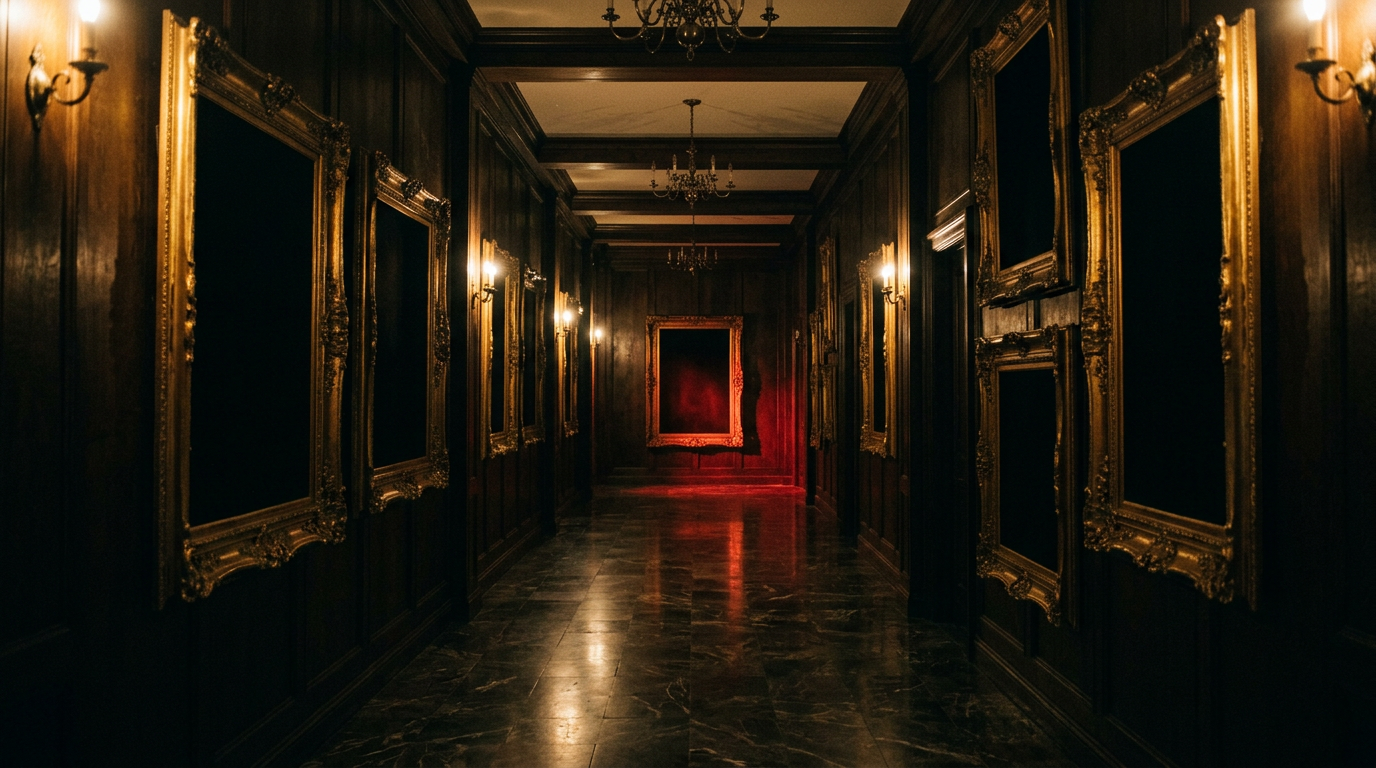
On December 8, 2010, a woman named Sarah emailed a company called Ocean's Bridge.
The message was brief. Painting ID: 58335. Painting name: Massacre of the Innocents 1591. She wanted it on canvas, twelve feet wide. For "a private residence."1
Ocean's Bridge is a commercial oil painting reproduction company. They hand-paint copies of masterworks for hotels, restaurants, and "over 10,000 individual art lovers." Their biggest prior commission was a 9-by-20-foot piece for a church in Chicago.2
Sarah's employer was not a church.
The Order
The back-and-forth took three weeks. Twelve feet was too large to ship — the courier limit was ten feet for the tube. James at Ocean's Bridge suggested nine feet by nine feet five inches instead. The canvas itself would be nine-six by nine-eleven, with a three-inch blank border for framing.1
Sarah forwarded the quote to her boss: $1,999 for the 9' x 9'5" size.3
"Would you still like to proceed with the painting?"
His reply, in full:
"proceed"4
On December 29, 2010, the order was confirmed. Order #204704. One oil painting, Massacre of the Innocents 1591, nine feet by nine feet five inches. $1,999.00. Shipping address: 9 East 71st Street, New York, NY 10021.5
That's Jeffrey Epstein's Manhattan townhouse.
By February, Sarah was following up on the timeline. By July 2011, the painting was hanging in the entryway. And then came the email that started this whole thread — Sarah writing to property manager Rich Barnett:
"Jeffrey is asking if you can Fedex the painting he had made of the Massacre of the Innocents to the ranch. It's the large 9'x9' canvas that we had rolled out for him to see in the entry way where they are killing babies. He wants to use it on the ranch."6
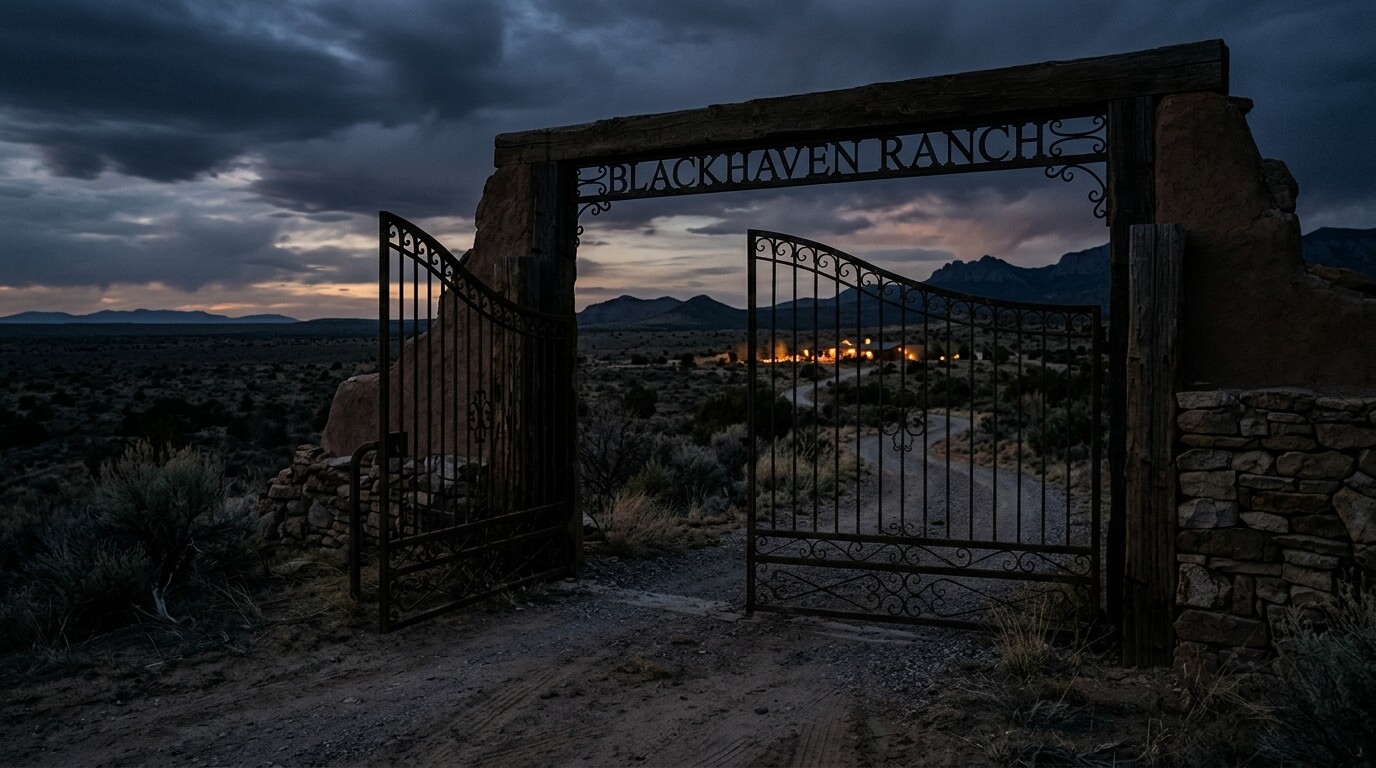
The ranch. Zorro Ranch, New Mexico. The property where Epstein told scientists he planned to "seed the human race with his DNA" by impregnating twenty women at a time.7
He wanted the painting of soldiers slaughtering infants shipped there.
The Original
The painting Epstein reproduced is The Massacre of the Innocents by Cornelis van Haarlem, painted in 1591. It hangs today in the Mauritshuis museum in The Hague. It depicts the biblical scene from the Gospel of Matthew: King Herod's Roman soldiers ripping infant boys from their mothers' arms and killing them to eliminate the newborn Christ.
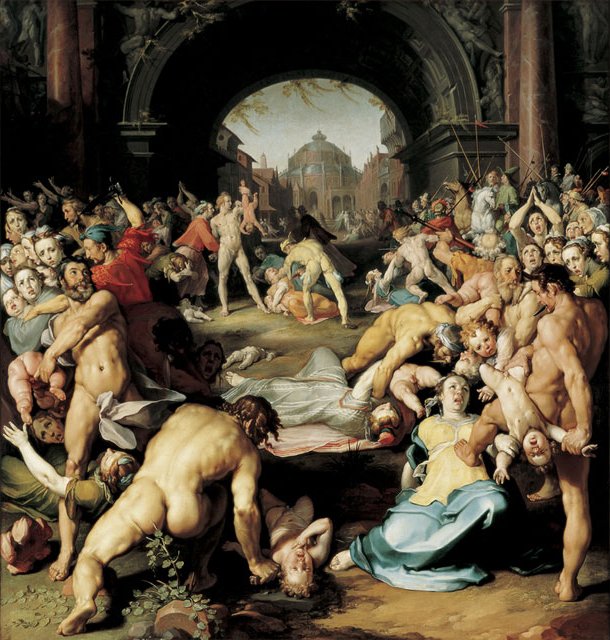 Cornelis van Haarlem, "The Massacre of the Innocents," 1591. Oil on canvas, 268 × 257 cm. Mauritshuis, The Hague.
It is 268 by 257 centimeters of Mannerist horror — writhing bodies, screaming mothers, dead children. Van Haarlem painted it with anatomical precision that makes the violence almost clinical.
Epstein had a nine-foot hand-painted oil reproduction made for two thousand dollars and hung it in the entry of the most expensive private residence in Manhattan.
The Worlds We Both Move In
Here's where it gets interesting. One month before Epstein ordered his $1,999 knockoff, he received an email from an art dealer named Mark offering him something rather different.8
"Dear Jeffrey, I have been asked by a notable collector of art to see if I can help him dispose of 2 major works privately... The two paintings in question are both world class paintings of museum quality — one by Rubens and one by Caravaggio. He is looking for $45M for the Rubens and $40M for the Caravaggio."
Mark explained the pricing context: the last major Rubens to sell was in 2002, to the late Kenneth Thomson in Canada, for $72 million. Its name?
The Massacre of the Innocents.
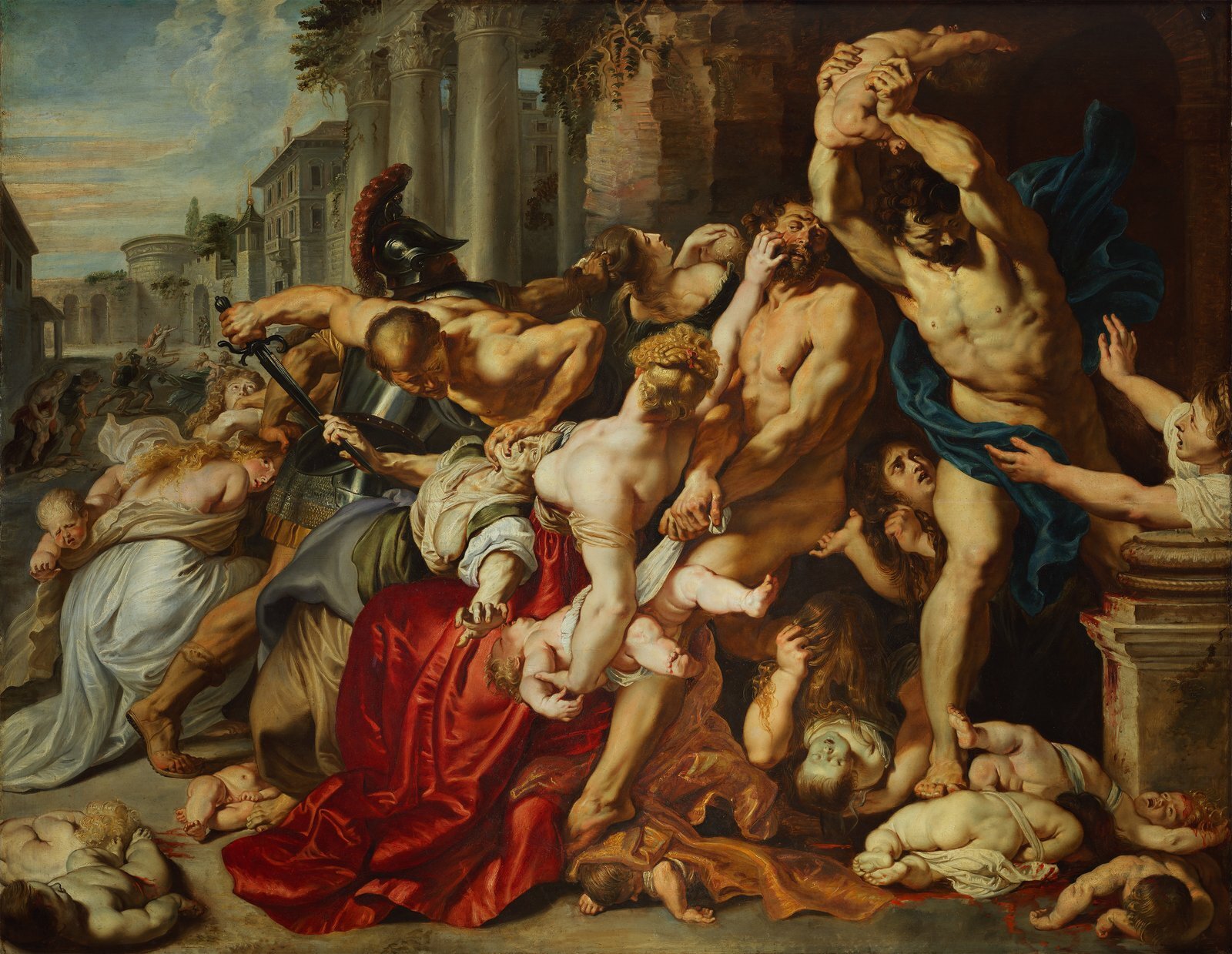 Peter Paul Rubens, "The Massacre of the Innocents," c. 1611. Sold at Sotheby's in 2002 for $76.7 million — then the most expensive Old Master ever auctioned. Now at the Art Gallery of Ontario.
"Given the worlds we both move in I thought I would let you know, just in case you know of any collectors who might be thinking of adding something like these to their collections."
Epstein's response: "how are yoy? what happned to forte's mothers house.. send photos of paintings."9
So in November 2010, Epstein was being courted as a broker for $85 million in Old Masters — Rubens and Caravaggio, museum-quality paintings. In December 2010, he ordered a $1,999 reproduction of the same subject from Ocean's Bridge. This wasn't a man who couldn't afford the real thing. His Sotheby's-appraised art collection was worth $265 million.10
He chose the knockoff. He chose the subject. And he chose where to hang it.
The Art Advisor
Two weeks before the Rubens and Caravaggio offer, another email arrived — this one from art advisor Francesca Amfitheatrof, writing after meeting Epstein in Paris.11
"It was really great to meet you on Tuesday in Paris, it was fun to looking through art works together and hear about your island."
She had a shopping list:
A Bruegel/Chapman Brothers painting — GBP 750,000. A Pieter Brueghel the Younger oil from 1607, bought at Sotheby's Amsterdam, then defaced by Jake and Dinos Chapman — contemporary artists famous for painting grotesque monster faces over Old Master crowd scenes. The Chapmans call it art. The result is a 400-year-old crucifixion scene populated by goggle-eyed demons with bleeding mouths.11
Paul Fryer's A Privilege of Dominion — GBP 145,000. A hyper-realistic waxwork gorilla — built with a Madame Tussauds technician — crucified on a wooden cross with iron nails, surrounded by rocks and dead tree branches. It had been displayed in a church in Marylebone. Fryer made it about human dominion over animals. What Epstein would have made it about is anyone's guess.11
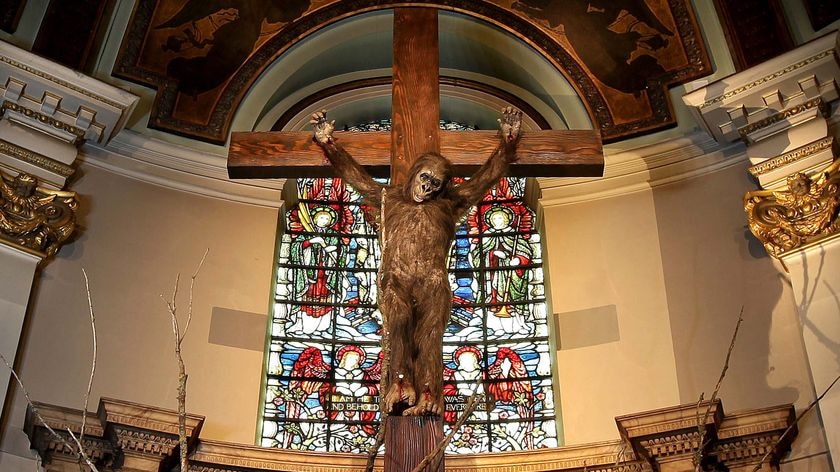 Paul Fryer, "A Privilege of Dominion," 2009. Waxwork gorilla, wooden cross, iron nails, dead tree branches. Offered to Epstein for GBP 145,000.
Polly Morgan's taxidermy bird piece. Dead birds suspended in artistic arrangements. Amfitheatrof confirmed "there are no conservation issues with her taxidermy art works. The only real problem that can arise is moths, as they feed off the keratin in the feathers."11
Zhang Huan's ash skull painting. Monumental paintings made from incense ash collected from Buddhist temples — millions of prayers reduced to pigment, rendered as enormous human skulls. Epstein already owned "Ash Skull No. 14" (appraised at $150,000). Amfitheatrof had bigger plans: "I still think the idea of The Last Supper in your dining room is incredible and worth pursuing."1011
A Last Supper made of cremation ash, hanging in a sex trafficker's dining room. No one blinked.
The Collection
The 2014 Sotheby's appraisal of Epstein's art collection runs seven pages.10 Two hundred works. $328 million paid. $265 million appraised. The names read like a survey course in Western art:
Manet. Picasso. Rothko. Matisse. Klimt. Rembrandt. Goya. Cezanne. Degas. Kandinsky. Schiele. Miro.
But look at the specific works, and a pattern emerges:
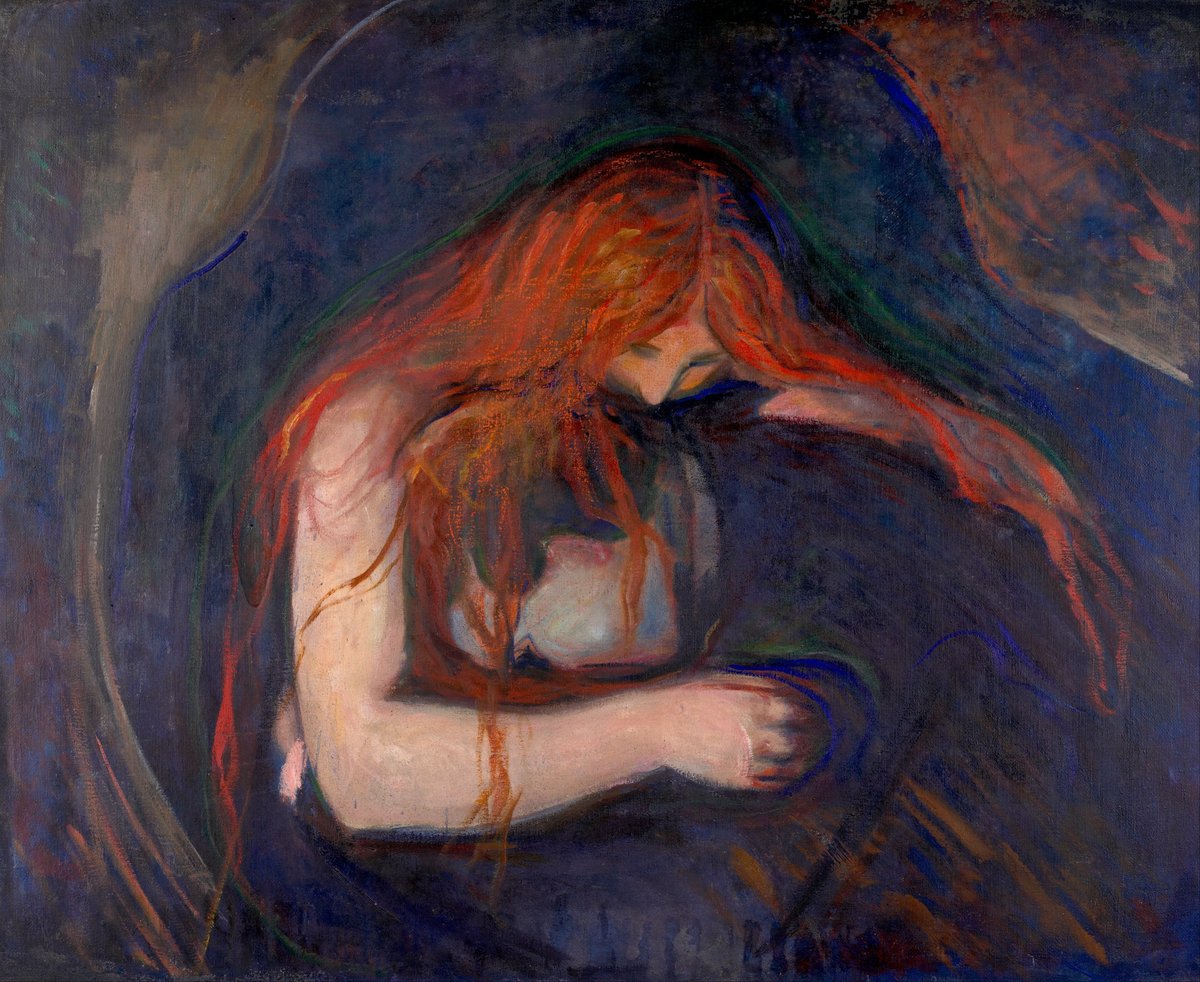 Edvard Munch, "Vampire," 1895. A figure draining the life from another. From Epstein's collection.
- Ensor, James — Devils Thrashing Angels and Archangels
- Durer, Albrecht — Coat of Arms with a Skull
- Zhang Huan — Ash Skull No. 14 (a human skull rendered in temple ash)
- Fuseli, Henry — A Threatening Head
And then there was this:
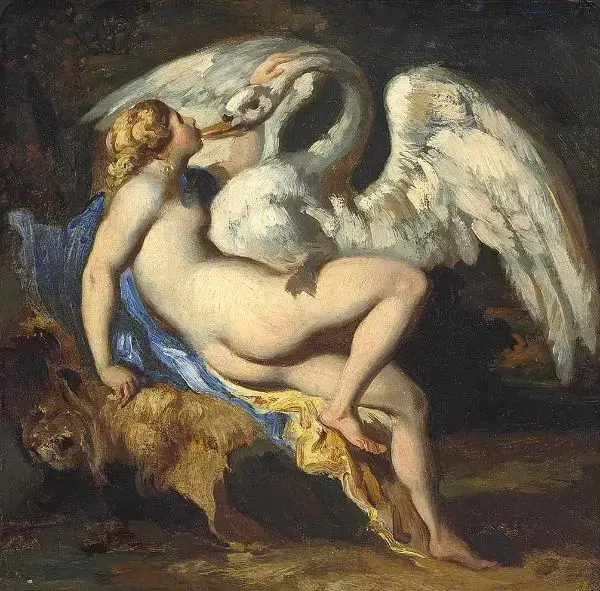 Theodore Gericault, "Leda and the Swan." The mythological rape of Leda by Zeus disguised as a swan. From Epstein's Sotheby's-appraised collection.
A painting of a mythological rape, in the private collection of a convicted sex trafficker. Appraised by Sotheby's. Insured. Catalogued. Legitimate.
Not every piece in the collection was an Old Master investment.
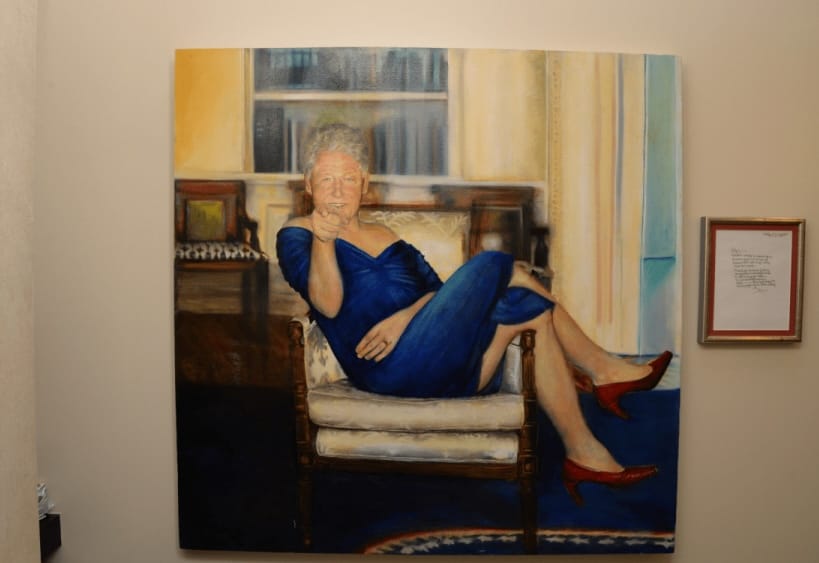 Petrina Ryan-Kleid, "Parsing Bill" (2012). Bill Clinton in a blue dress and red heels, reclining in the Oval Office. Photographed hanging inside 9 East 71st Street. From DOJ files.
A painting of a sitting president cross-dressed in the most famous garment in scandal history, hanging in the home of the man who flew Clinton to his private island twenty-six times. The artist, Petrina Ryan-Kleid, said she had no idea Epstein had acquired it.
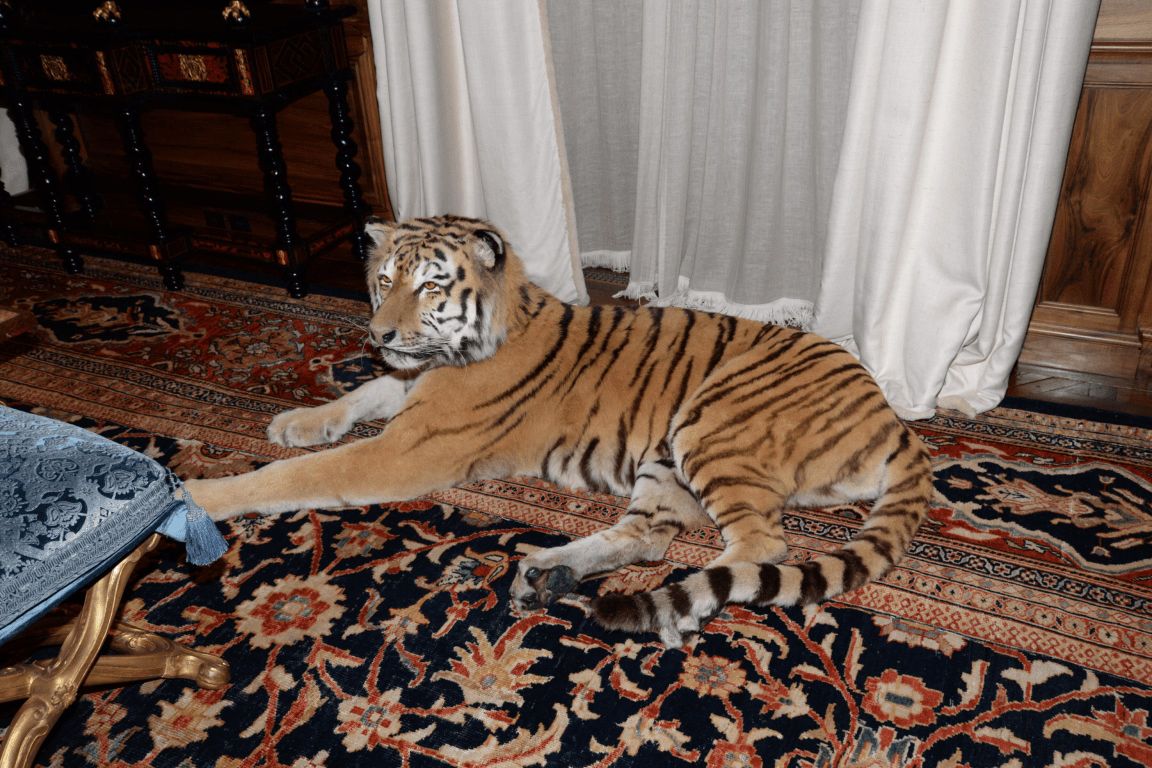 A taxidermy tiger on the floor of the piano room. 9 East 71st Street. From DOJ files.
The Entry Hall
Vicky Ward described it first in Vanity Fair in 2003. The entrance hall of 9 East 71st Street — the largest private residence in Manhattan — was lined with rows of individually framed prosthetic eyeballs, imported from England, originally manufactured for soldiers who had lost eyes in combat.12
Visitors walked past dozens of glass eyes staring out from frames before they reached the living room. Beside them stood a twice-life-size sculpture of a naked African warrior. The interior was designed by French decorator Alberto Pinto.
Over the staircase, suspended from a rope against a painted sky mural, hung this:
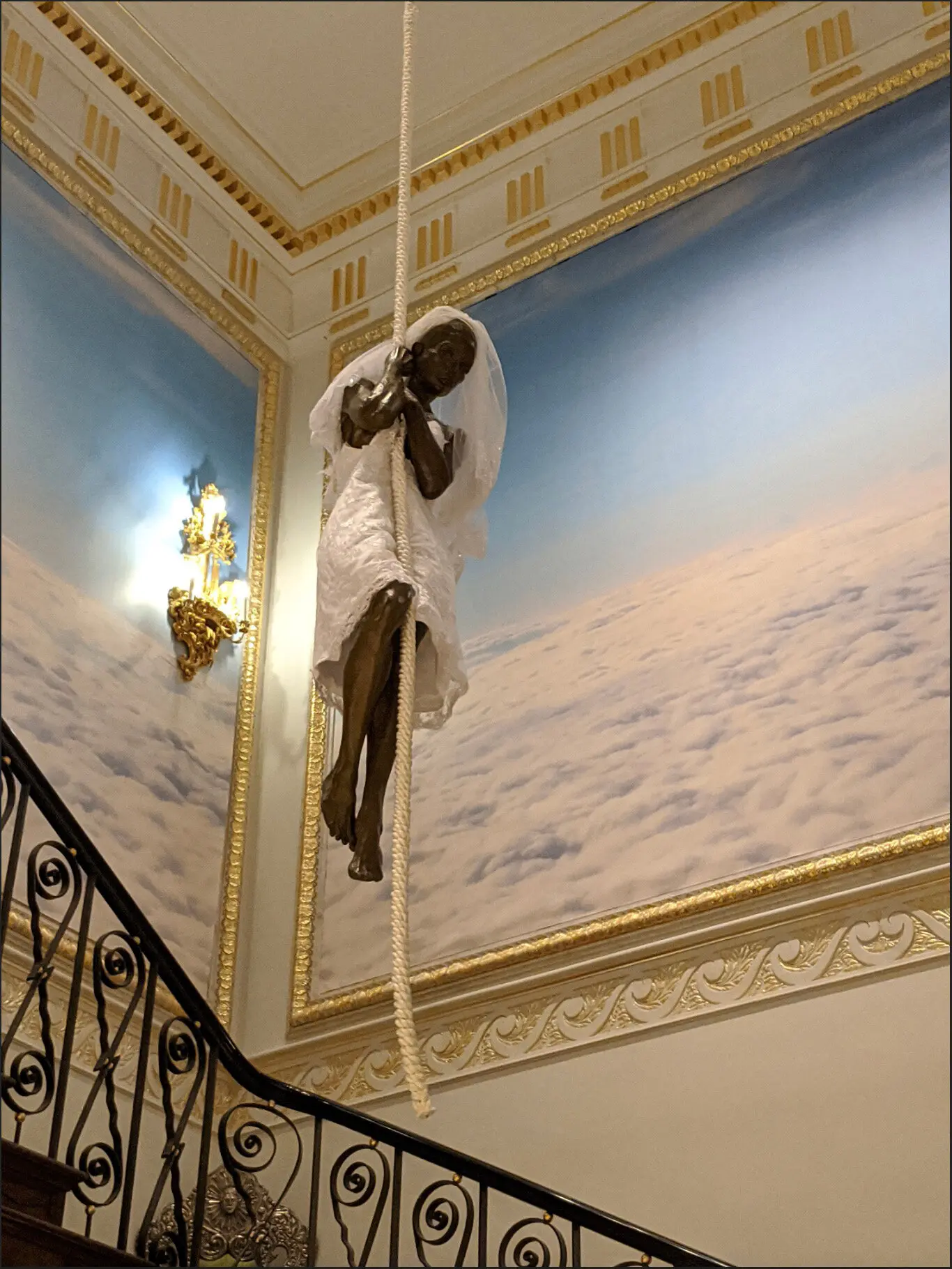 A sculpture of a young girl in a white dress, hanging from a rope in the stairwell of Epstein's Manhattan townhouse. 9 East 71st Street. Photo from DOJ files.
And then there were the masks.
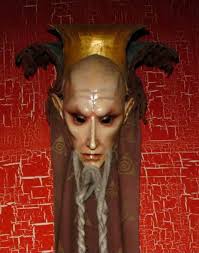 A mask displayed in Epstein's Manhattan townhouse. 9 East 71st Street. Photo from DOJ files.
This was the same entry hall where Epstein hung the Massacre of the Innocents reproduction before shipping it to the ranch.
The Island
The properties told the same story at every scale.
On Little St. James, John Christensen — who managed the island — emailed staff in July 2014 with a punch list of tasks. Mixed in with "power wash the walls at master bath" and "buy new flowers, something nice please, not dead Home Depot flowers":13
"Get two statues from chillax room taken to the office."
"Please ask JE where he wants artwork hung in cabana I."
"Frames with bugs/butterflies in chillax room to be hung at flag pool."
The "chillax room." Where the bug-and-butterfly frames lived alongside whatever statues were being rotated to the office. This was a man who micromanaged art placement on a private island while simultaneously requesting "larger dolls" be brought to Paris.14
And then there was the dental room.
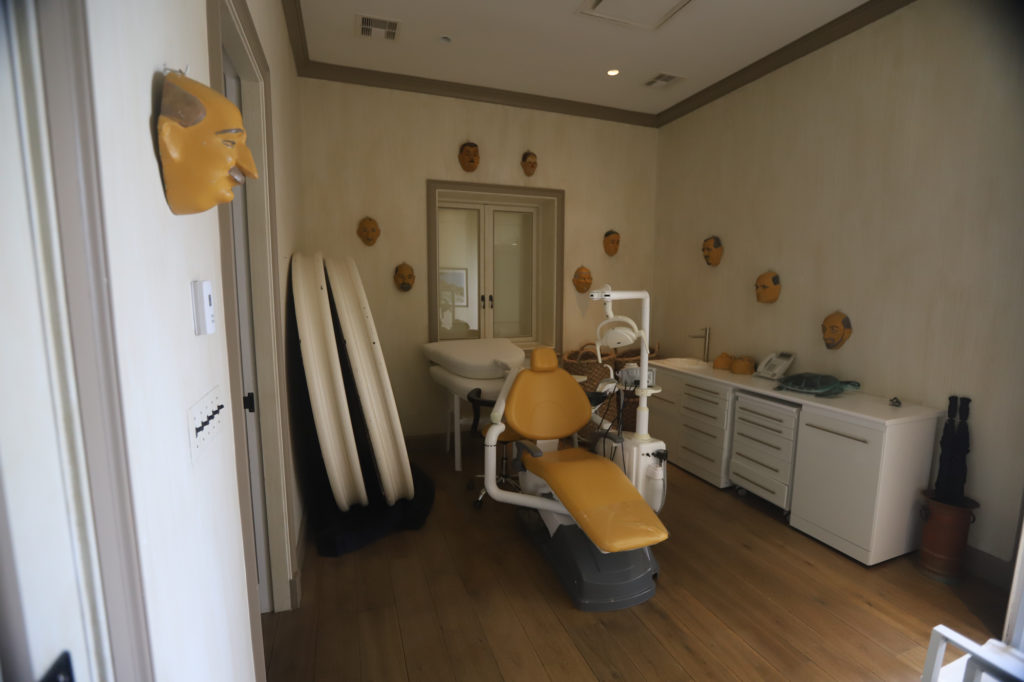 A fully equipped dental office on Little St. James island. Face masks hung on the walls like trophies. Photo from DOJ files.
A professional dental chair on a private island. On the walls: face masks — not decorative abstractions, but molded human faces, hung at intervals around the room like a collection.
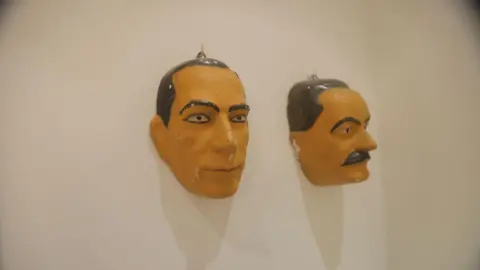 Closeup of two masks from the dental room walls. They appear to be caricatures of specific individuals. Little St. James island. Photo from DOJ files.
Outside, the temple — the gold-and-blue-striped structure visible in aerial photos — had its own ceiling mural.
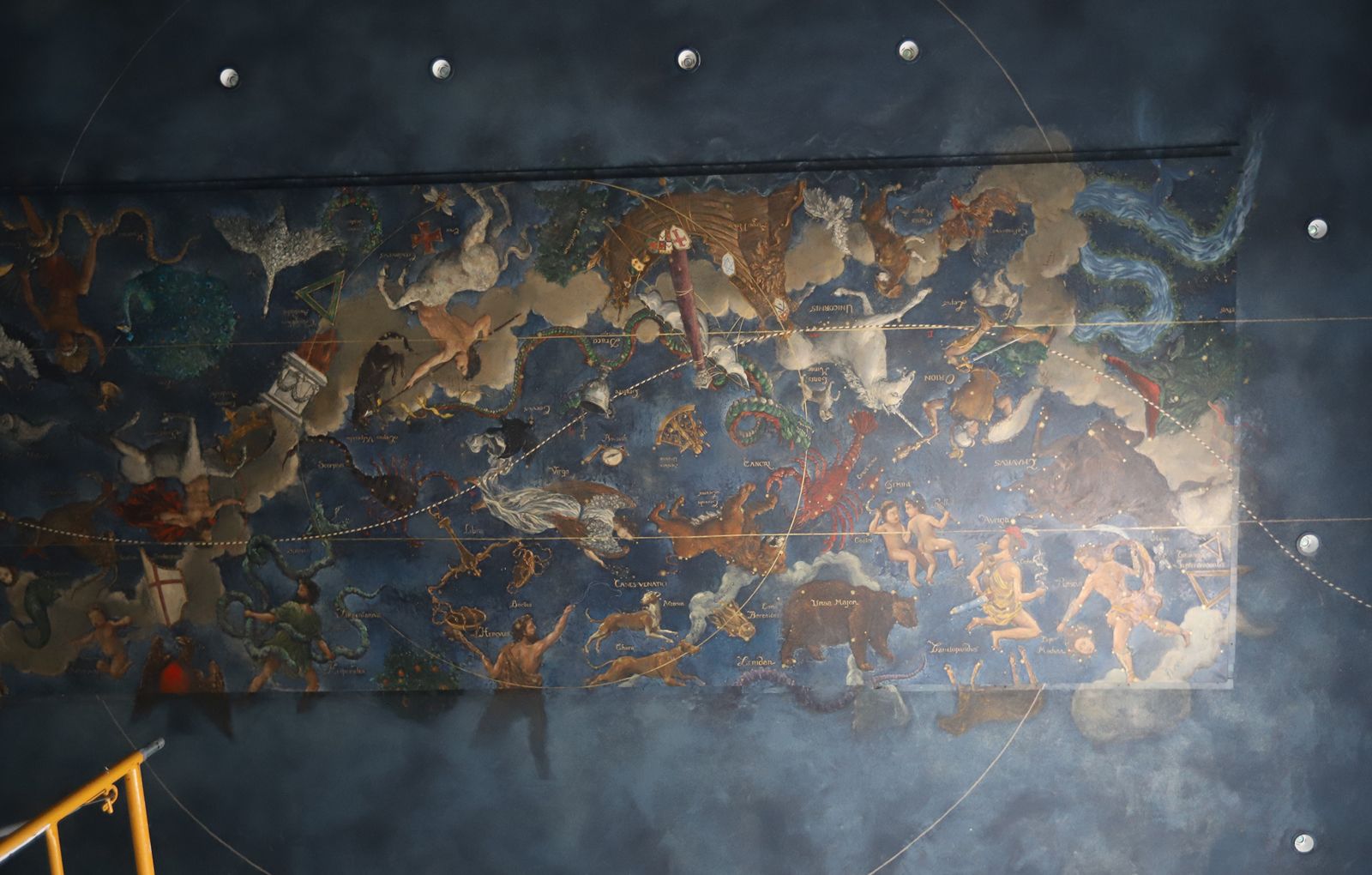 The ceiling inside the temple structure on Little St. James. A zodiac-style mural depicting mythological figures. Photo from DOJ files.
Paris
The pattern repeated across the Atlantic. Epstein's apartment on Avenue Foch — eighteen rooms overlooking the Arc de Triomphe — was raided by French police investigating the Brunel case. The photos, released in February 2026, showed what investigators found inside.
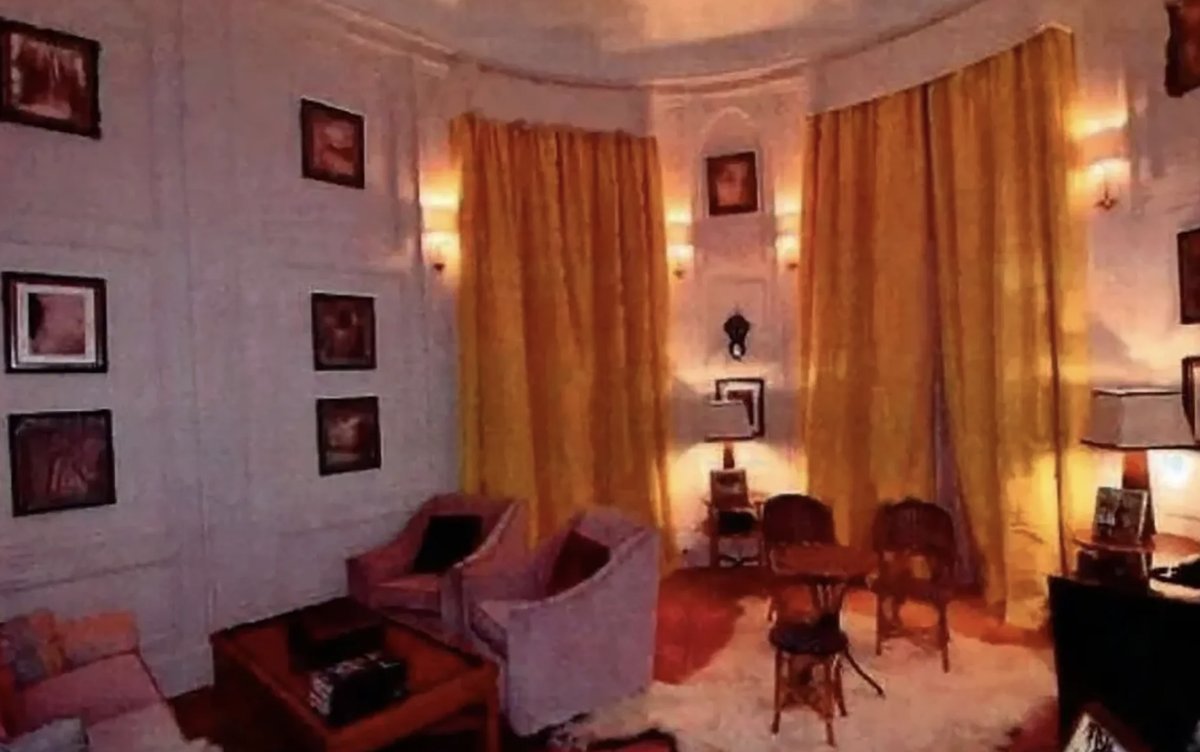 The rotunda of Epstein's Paris apartment, Avenue Foch. Framed photographs cover every wall. French police evidence photos, released 2026.
Every wall covered in framed photographs. Gold curtains. A bearskin rug. Stuffed animals — an elephant calf, a vulture. Sex toys in the drawers. Nude photos throughout. Eighteen rooms decorated like a predator's fever dream, in the most expensive arrondissement in the world.
What the Walls Say
There are two ways to read this.
The charitable read: Epstein was an art collector with eclectic tastes who happened to like dark subject matter. Lots of wealthy people collect disturbing art. The Chapman Brothers are in major museums. Paul Fryer exhibited in churches. Zhang Huan is represented by Pace Gallery.
The other read requires looking at the whole picture. Not just what he bought, but where he put it. The painting of babies being slaughtered — in the entryway of his home, then shipped to the ranch where he planned to breed women. The prosthetic eyeballs — staring at every person who walked in. The crucified ape — offered for the home of a man convicted of sex crimes against children. The ash skulls — made from the residue of prayers, decorating the walls of a predator's fortress.
The $265 million collection included Rembrandts and Picassos. Those are investments. The $1,999 Massacre of the Innocents was not an investment. It was a choice — a nine-foot, hand-painted declaration of what Jeffrey Epstein liked to look at every day when he walked through his front door.
The entry way where they are killing babies.
He wanted to live inside that painting.
Sources & Documents
- EFTA02320607 — Sarah K to Ocean's Bridge, initial inquiry and sizing discussion (Dec 2010). View →
- EFTA00560320 — Sarah K confirms order with Ocean's Bridge, full email chain. View →
- EFTA01779255 — Sarah K forwards quote to Epstein: "$1,999 for the 9ft by 9ft 5 inch size." View →
- EFTA00901209 — Epstein's reply: "proceed." Full email chain with Ocean's Bridge details. View →
- EFTA02319842 — Order confirmation #204704, shipping to 9 E. 71st St. View →
- EFTA00563164 — Sarah K to Rich Barnett: FedEx the painting to the ranch (Jul 2011). View →
- New York Times, "Jeffrey Epstein Hoped to Seed Human Race With His DNA" (Jul 2019).
- EFTA02408496 — "Mark" to Epstein: Rubens ($45M) and Caravaggio ($40M) for sale (Nov 2010). View →
- EFTA00777106 — Epstein's reply to Mark: "send photos of paintings." View →
- EFTA01199570 — Sotheby's 2014 art appraisal, 7 pages, 200+ works, $265M total. View →
- EFTA00732672 — Francesca Amfitheatrof to Epstein: Chapman/Bruegel, crucified ape, taxidermy, ash skulls (Oct 2010). View →
- Vicky Ward, "The Talented Mr. Epstein," Vanity Fair (Mar 2003); Wikipedia entry on Epstein's townhouse.
- EFTA01919446 — John Christensen to Ann Rodriguez: LSJ island art/property management (Jul 2014). View →
- EFTA00926244 — Epstein to Sarah K: "bring them to paris.. please get some more. or larger dolls." (Dec 2011). View →